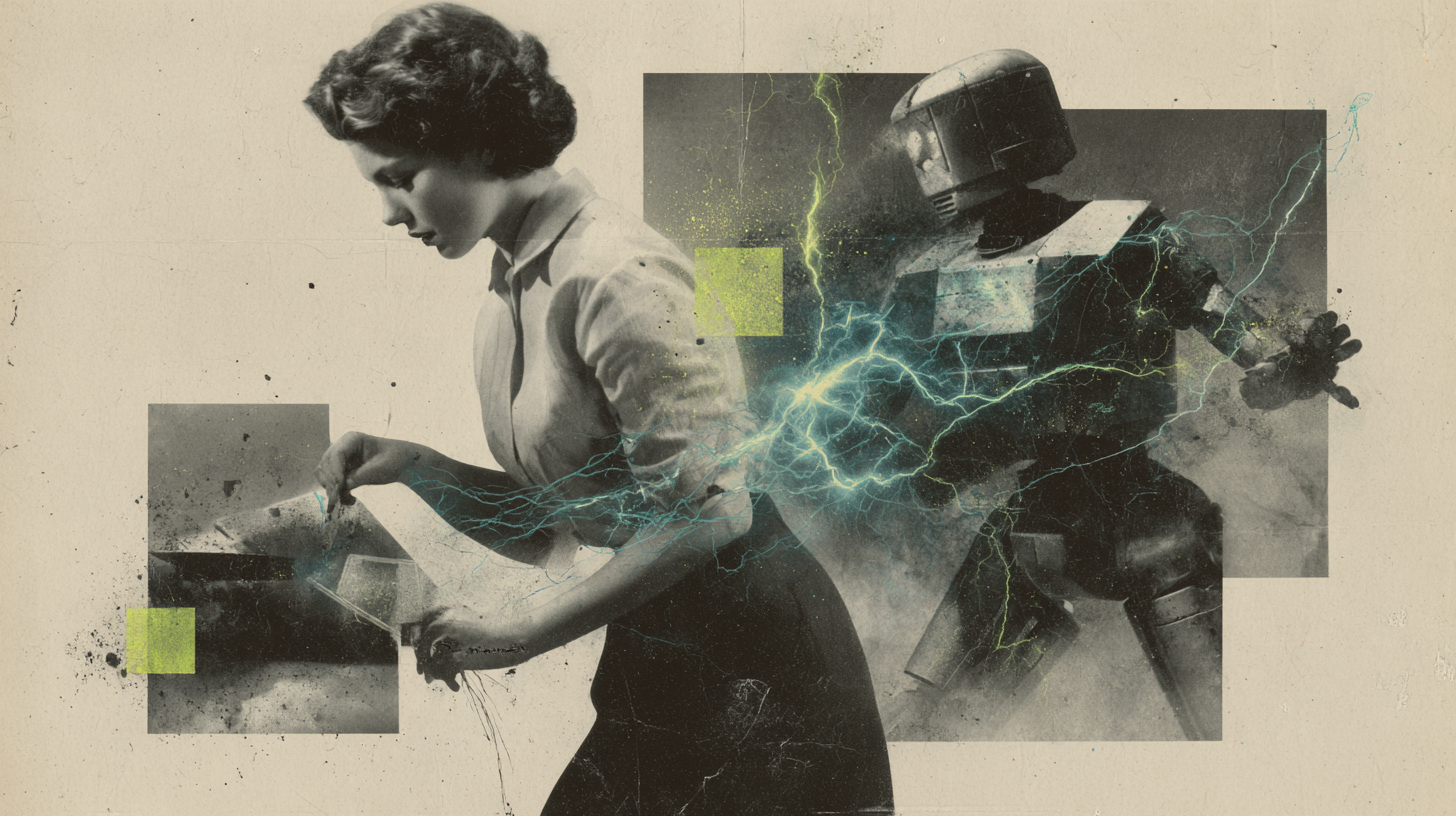
AI doesn’t scare me.
What scares me is how fast it’s starting to sound like us.
I spent part of last week testing Google’s new experimental tool, Pomelli, which dropped into Labs without much fanfare. On the surface, it’s simple: feed it your website, let it study your tone and language, and it starts writing social posts that mirror your brand voice. It doesn’t just pull from what you say—it studies how you say it. The pacing, the phrasing, the cadence. It learns your rhythm and begins to write as you.
That’s both remarkable and unnerving. AI isn’t just trained on data—it’s being trained on identity. It’s learning the digital DNA that makes you, you.
If you’ve ever worked in marketing, you can feel the weight of that shift. For years, we’ve treated AI like a clever assistant—a tool to help summarize, ideate, or automate. But Pomelli represents something deeper: a collaborator studying your creative fingerprint and producing work in your likeness. It’s not there yet, but it’s close enough that you can see the silhouette of what’s coming.
And that silhouette changes everything.
Marketing has always been chaos—the constant juggling, the endless to-do list that never shrinks. Small and mid-sized businesses are built on multi-hat marketers who write blogs, run ads, manage email, shoot photos, edit videos, and somehow keep the brand voice consistent across every channel. They’re the backbone of the modern marketing ecosystem, and they’re stretched impossibly thin.
For them, a tool like Pomelli is a gift. A digital clone of their creative mind—a system that can speak their voice back to them. It’s like suddenly having a team of ghostwriters, designers, and strategists working from the same neural blueprint. It won’t replace intuition or audience understanding, but it gives them the one thing no marketer has enough of: time.
Right now Pomelli feels like a toddler with immense potential. It can imitate tone but doesn’t yet understand context. It can string words together beautifully but doesn’t know when to stay quiet. It might get you a few good posts, but it’s not going to revolutionize your strategy. Not yet. Still, once it ties into analytics, your CMS, your brand assets, and generative models like Nano Banana, it’s not hard to see the curve forming. Soon you’ll have a system that generates content at scale, tuned by your audience data—learning from what resonates and what falls flat. It’s not just AI writing for you; it’s AI becoming fluent in your voice.
For the in-house marketer, that’s empowerment. For the agency world, that’s disruption.
Agencies have been built on expertise—on specialization. The social strategist who breathes platform algorithms. The paid media pro who can stretch a dollar across twelve ad sets. The SEO who reverse-engineers an algorithm update in an afternoon. Agencies exist because mastery takes time, and no single person can master it all. Clients rely on agencies to bring depth where they have only surface.
AI is about to challenge that model—not because it replaces experts, but because it blurs the line between expertise and efficiency.
Picture this: an in-house marketer plugs Pomelli into their brand assets. It learns their voice, connects to GA4, analyzes past campaigns, and starts suggesting post variants that statistically perform better. That person suddenly has something that feels a lot like an agency in a box. They don’t need retainers, timelines, or pitch decks. They just prompt the machine. It won’t outperform a team of specialists—but it might be “good enough.” And “good enough” has a habit of reshaping industries.
That’s where my unease comes in. What’s at stake isn’t the creative process—it’s the perception of value. To someone outside marketing, these tools don’t represent nuance; they represent efficiency, cost savings, and output. And that’s dangerous, because marketing has never been about output—it’s about impact.
I’ve already heard the whispers: CFOs and COOs asking, “Why are we paying an agency when someone in-house could use AI?” That mindset isn’t evil—it’s economic. But it’s flawed. It assumes writing is marketing, that design is strategy, that consistency equals clarity. It forgets that behind every great campaign is insight—the kind of human understanding no model can yet replicate.
The marketers and agencies who survive this shift will be the ones who stop seeing AI as competition and start seeing it as amplification. The ones who use it to make their expertise louder, not cheaper. The strategist who tests messaging hypotheses before going live. The SEO who drafts with AI and then refines manually. The creative director who uses AI to generate ten storyboards in an hour, freeing time for storytelling. The future isn’t displacement—it’s evolution.
But make no mistake: AI will force the agency model to evolve.
Billable hours? Irrelevant.
Output quotas? Automated.
The new measure of value will be insight velocity—how fast you can turn understanding into action.
Agencies that thrive will embed AI into workflows, not as gimmick but as infrastructure. Prompt engineers will become the new production assistants. AI strategy will become the new creative ops. Every team will have to ask: how do we charge for thinking, not typing?
This won’t kill agencies—it will expose them. It will separate the true strategic partners from the factories for deliverables. Those who sell thought leadership will thrive; those who sell time will not.
What excites me about Pomelli isn’t what it is—it’s what it represents. It’s a signal in the evolution of creative technology, the early stages of brand-specific intelligence. I don’t see a social-post generator; I see the first step toward a unified brand layer that connects directly to every other Google property. Imagine an AI collaborator that not only writes content but cross-analyzes your site performance, search visibility, ad conversions, and audience behavior. It drafts not just posts but strategies—and it does all of this in your voice.
That’s where marketing is heading. Less about creating content, more about training systems that can create on our behalf. The human role shifts from creator to conductor.
But what still bothers me isn’t technology—it’s people.
Every time an organization automates creativity, someone with a spreadsheet inevitably tries to automate the people who make it possible. You can picture it: a leadership meeting, a CFO watching an AI demo saying, “We can cut costs. We don’t need a creative team—just someone to run prompts.” And that’s where the real danger lies. Not in AI’s capability, but in our willingness to undervalue human expertise the moment a machine can imitate its outputs.
AI won’t destroy marketing. Short-sighted leadership might.
Every new tool follows the same pendulum swing: panic, over-adoption, then equilibrium. We saw it with social, automation, analytics—and we’ll see it again with generative and agentic AI. Companies that fire their teams and rely on machines will see a short burst of productivity and a long decay of creativity. The ones that pair human insight with AI assistance will redefine what efficiency means.
That’s the nuance people miss. AI doesn’t remove the need for expertise—it raises the bar. It demands we understand our craft so deeply that we can teach it to a machine. It forces us to articulate what we once just felt. It makes the implicit explicit. And that’s a kind of mastery most marketers haven’t faced before.
AI isn’t killing creativity—it’s demanding we understand it.
Eight months ago, I couldn’t have imagined the tools we have today. “Claude Code” wasn’t even a phrase people used. Now developers deploy functional apps in a weekend with AI copilots. That’s not hype—it’s a shift in production physics. The same shift is coming for marketing. We’ll move from concept to campaign in hours, not weeks. We’ll brainstorm, brief, and build in real time alongside machines that understand our goals. The work will still be ours—it’ll just happen faster, more fluidly, and with fewer bottlenecks.
This isn’t the end of marketing. It’s the start of a new industrial evolution.
The last one gave us assembly lines and scale. This one gives us intelligence and adaptability.
Instead of people building machines, we’re building systems that think with us.
It’s easy to get cynical about the pace. Every day there’s another launch, another “game-changer.” Most won’t survive. Some will. The market will correct itself. But beneath the noise, there’s a clear trajectory: we’re moving toward a world where human-machine collaboration becomes the default mode of work.
And that’s what makes this both thrilling and humbling.
Tools like Pomelli don’t represent replacement—they represent reflection.
They show us who we are through the data we’ve already left behind.
They amplify the voices we’ve built online, for better or worse.
They learn from us in real time.
That’s not science fiction—that’s a mirror.
So when people ask what scares me most about tools like Pomelli, my answer isn’t that AI will take jobs or ruin art. My fear is that people will mistake imitation for insight. That leaders will see the surface and ignore the substance. That we’ll start trusting the mirror more than the human standing in front of it.
AI isn’t the enemy.
Ignorance is.
Because the marketers who survive this era won’t be the ones who fight the machines.
They’ll be the ones who learn to teach them.